
- News
- City News
- delhi News
- Delhi: Cautious start to first trade fair of Covid era
Trending
This story is from November 15, 2021
Delhi: Cautious start to first trade fair of Covid era
On the first day of the 40th edition of India International Trade Fair (IITF) at Pragati Maidan, exhibitors from across states and a few countries saw a gradual influx of visitors.
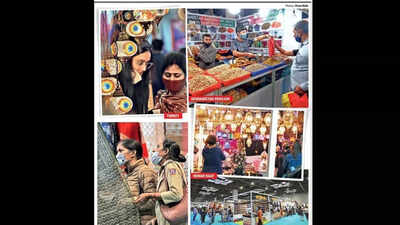
However, due to the pandemic, only nine countries turned up against the 23 participants in 2019. For the exhibitors from Afghanistan, Bahrain, Bangladesh, Iran, Nepal, Tunisia, Sri Lanka, Turkey and UAE, the event is of a major significance as it is being held after a one-year gap.
The key highlight was the participation of artisans at the Bihar stall, the event partner state, and at SARAS 2021 being organised by NIRD and Panchayati Raj.

Artisans and SHGs from across 28 states displayed their items at the SARAS mela. Silk and cotton sarees from Odisha, Bihar and Chhattisgarh, bedsheets from Uttar Pradesh, Kantha sarees from West Bengal and bamboo art and water hyacinth products from Assam were displayed there by MSMEs.
Inside the newly inaugurated exhibition hall, the Bihar stall presented its traditional Madhubani, Manjusha and Sikki art forms on terracotta and textiles. “We have 41 stalls representing Bihar this year against 34 in 2019. We will have a live demonstration of Madhubani paintings by Dulari Devi, an artist from the lowest strata,” said Ashok Sinha, organising director.
Uttar Pradesh, a focus state at the fair, had 124 exhibitors from across its districts representing it as a brand. Among the 30 states and Union Territories, Nagaland and Karnataka did not turn up. Jharkhand was another focus state.
A few visitors were seen confused at the Hunar Haat pavilion of the ministry of minority affairs. All state and country stalls were scattered across the new exhibition halls 2, 3, 4 and 5. “The four halls are interconnected and appear like one big hall. It is difficult to figure out the stalls without any help,” said Seema Kumari, a visitor.
An exhibitor at the Turkey stall, Harulla Karpus, who had put up a display of handmade ceramic items, said, “The exhibition is hardly seeing visitors on Day 1 compared with past years. There are only three exhibitors from Turkey this year.”
There were 20 exhibitors from Afghanistan displaying dry fruits. The country’s exhibitors didn’t travel to India because of the travel restriction amid the political turmoil in their country. Maria and Khaliza, exhibitors at the Iran stall, were hopeful of selling their traditional gold-plated jewellery, but sale was low for them on Day 1.
There was a live performance of Fusion Yoga by practitioners from Morarji Desai National Institute of Yoga, free medical consultation by experts of various Ayush streams and display of various food items promoting nutrition and good health at the pavilion of the ministry of Ayush. The activities revolved around the theme of holistic health. Various institutes and research bodies of Ayurveda, Yoga and Naturopathy, Unani, Siddha and Homeopathy streams had set up their counters in hall number 10.
While there were boards on display reiterating Covid-19 precautions, thermal detectors and sanitisers were not available at the entry gates. Many exhibitors and visitors were seen without masks.
Till Friday, the fair would be for B2B participants and open for the general public from Saturday. The price of entry passes would reduce to Rs 80-120 from Friday against the current Rs 500. More crowds are expected on the weekend.
End of Article
FOLLOW US ON SOCIAL MEDIA


Hot Picks
TOP TRENDING
Trending Stories
In City
Entire Website
- UPI transaction limit to change from September 16! Here are the new limits for various UPI payments
- GK for students: 7 Fascinating Features of These Unique Birds
- No look shot gone wrong! Pakistan batter hilariously trolled after dismissal. Watch
- Andhra suspends 3 IPS officers for 'framing', arresting Mumbai actress
- UP medical aspirants converting religion to secure MBBS seats: A look at NEET UG admission criteria around minority reservation rules
- Who is Ryan Wesley Routh? Man held for 'apparent assassination attempt' on Trump
- Virat Kohli at his destructive best, shatters Chepauk wall near India dressing room with six
- 'Prince Harry is not even the spare to his wife': Meghan Markle’s treatment of Duke under fire
- Vince McMahon’s Expensive Properties, Bungalows, Villas, Private Jet, Car Collections, and More
- "Miami Dolphins Owner Stephen Ross Eyes Multi-Billion Dollar Deal: The $7 Billion Power Play"
- 15 phones, knives, omelette stoves found in prison where actor Darshan was 'relaxing'
- Trump assassination bid: Suspect 'planned' to recruit Afghan soldiers in Ukraine
- Are employers liable when #MeToo moments happen out of office?
- Thank CJI for not giving ‘next date’ to Bappa: Uddhav Thackeray
- Stellar debut for Bajaj Housing Finance; shares list at 114% premium
- Woman 'disrobed, molested, photographed' at Kolkata hospital by ward boy
- Will BJP pay the price for angering pehalwan, kisan, jawan in Haryana?
- Apple's biggest 'iPhone update' for 2024: India time, how to prepare
- Ex-principal's Sandip Ghosh's polygraph test leaves more questions than answers
- When Gautam Gambhir shared his Man of the Match award with Virat Kohli

Popular Categories
Hot on the Web
Top Trends
Who is Ryan RouthUPI Transaction LimitArvind Kejriwal ResignationNEET UG Admission CriteriaYounis KhanBorder Gavaskar TrophyRohit SharmaSports Stars Turned Power CouplesIBPS RRB Clark PO ResultDonald TrumpBianca Belair Net WorthVivek RamaswamyBMW Accident Madhya PradeshIndore BMW CrashPrince HarryMiami Dolphins OwnerLive Cricket Score
Trending Topics
Living and entertainment
Latest News
Odisha to join Ayushman plan; Delhi, Bengal to be only holdouts4 types of tea to improve gut health and ease digestive issuesWhen Shah Rukh Khan performed 'Kanyadaan' at Farah Khan's wedding- See PICSFather-son duo Eugene and Dan Levy's dazzling entrance at the Emmys'Will hug my kids extra tight tonight': JD Vance after Trump 'assassination attempt'Bengal govt blames junior docs for logjam but sends fresh offer for talksLodi-era mosque collapses in AgraVineet Kumar Singh calls Superboys of Malegaon standing ovation at TIFF a 'magical experience': 'I can still hear the clapping and whistling" - ExclusiveLast Lunar Eclipse of 2024: What it means for your zodiac signKavin and Nelson's fan moment with Ajith KumarAce product management with IIM Lucknow’s Executive Programme in Data-Driven Product Management'India best bet in 21st Century': PM Modi inaugurates 4th Global Renewable Energy Investor's meet in GujaratKejriwal says he will quit as CM in 2 days, wants aam aadmi's 'honesty certificate'Jessica Gunning wins her 1st Primetime Emmy for 'Baby Reindeer'‘Stree 2’ star Shraddha Kapoor to reveal her character name! But there’s a catchSathiyan set to partner Sreeja in mixed doubles'Seven varsities in Odisha have potential to be in top 100'Capricorn, Daily Horoscope Today, September 16, 2024: Harmonious relationships with partners are likely
Copyright © 2024 Bennett, Coleman & Co. Ltd. All rights reserved. For reprint rights: Times Syndication Service